File returns, make payments, check refund status, and manage your account, all in one place. Creating a new account is the best way to track your filing history, view notices, and manage your account over time. For more information, please visit our Maryland Tax Connect Information Hub.
Organization Of The FEB
Organizational Breakdown
I. Legally Mandated Authority/History of Field Enforcement Bureau
The Field Enforcement Bureau (FEB) was established in 1999, after Comptroller William Donald Schaefer elected to take a proactive approach to addressing tax crime violations. The Bureau was comprised of three smaller units which had been established in the Comptroller’s Office: The Motor Fuel Testing Lab; The Enforcement Section (Investigative Services Unit); and The License Bureau.
In January 2004, Comptroller Schaefer merged the Alcohol and Tobacco Tax Division with the Field Enforcement Bureau, establishing the Regulatory and Enforcement Bureau. In October 2005, Comptroller Schaefer continued with his efforts to streamline regulation and enforcement operations and consolidated the Motor Fuel Tax Bureau and the Regulatory and Enforcement Bureau creating one division. These mergers created four Bureaus within the Division: The Alcohol and Tobacco Tax Bureau; The Field Enforcement Bureau; The Motor Fuel Tax Bureau; and The State License Bureau. In May of 2007, and after the election of Peter Franchot as Comptroller, the Motor Fuel, Alcohol, and Tobacco Tax Division was created. In 2021, through legislative action by the Maryland General Assembly, the Maryland Alcohol and Tobacco Commission (ATC), now known as the ATTC, was created. The regulatory authority over the alcoholic beverage and tobacco industries subsequently transferred from the Comptroller’s Office to the ATCC. However, the taxing authority of alcoholic beverages and tobacco products was retained by the Comptroller.
The Field Enforcement Bureau, by authority of the Tax General Article 2-107, is responsible for enforcing the laws relevant to the following tax/license types and associated industries:
- Admission and Amusement Tax Income Tax
- Income Tax and Income Tax Preparation
- Motor Carrier Tax
- Motor Fuel and Lubricants
- Motor Fuel Tax
- Sales and Use Tax
- Transient Vendor Licenses
- Business Licenses
- In cooperation with the ATCC, the Alcoholic Beverage and Tobacco Taxes
Personnel of the Field Enforcement Bureau who are sworn police personnel derive their powers of arrest from the Annotated Code of Maryland, Alcohol Beverage, and the Tax General Articles. All police personnel are certified through the Maryland Police and Standards Commission in accordance with Article 41, Section 4-201 of the Annotated Code of Maryland.
II. ADMINISTRATION
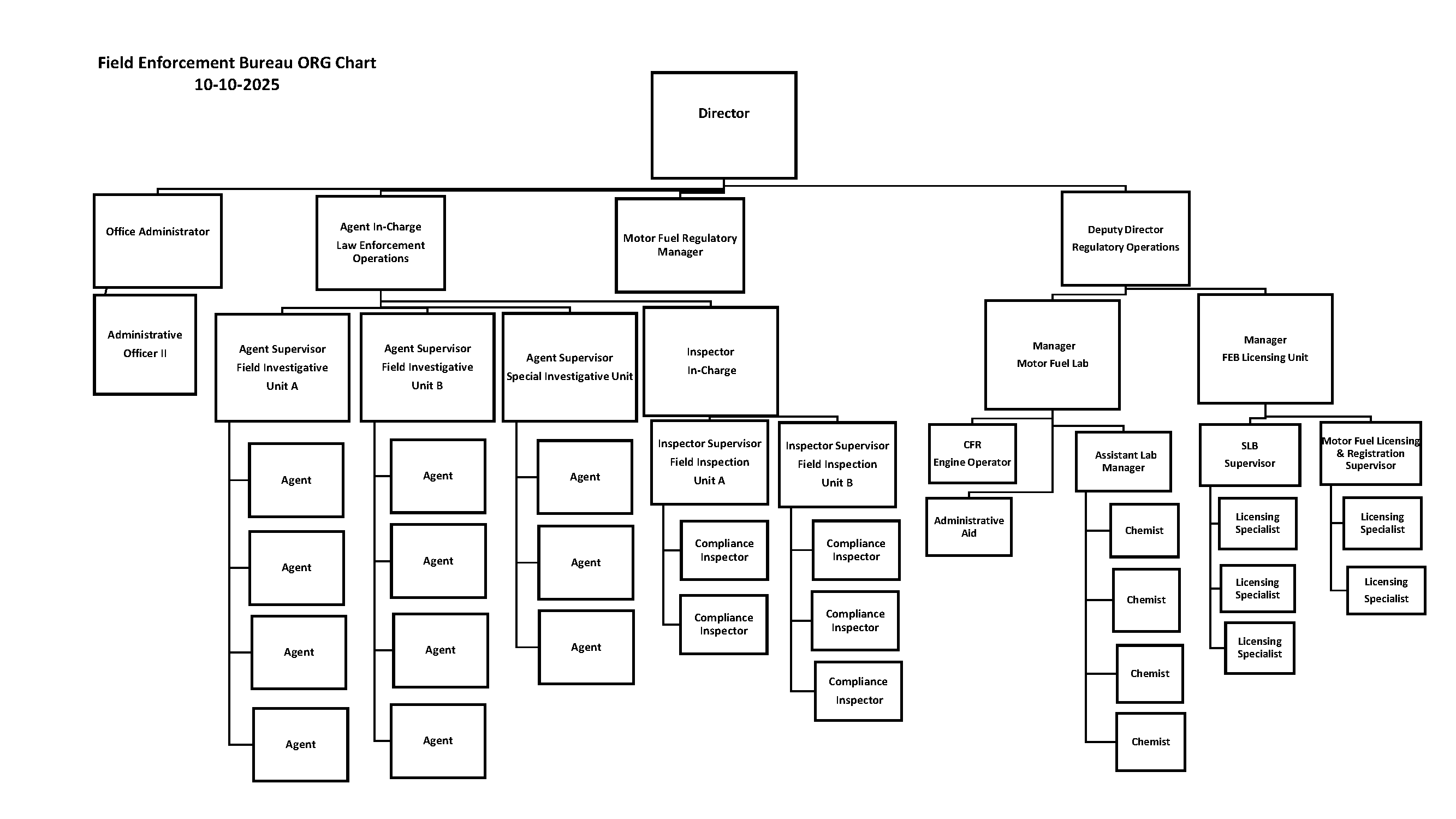
Director: The Director is responsible for the general administration and control of the Field Enforcement Bureau. The Director reports to the Comptroller of Maryland or their designee. The Director is responsible for the overall operation of the bureau and is responsible for the efficiency and general conduct of the bureau. In addition to everyday duties, the Director meets with other directors of the Comptroller’s Office, recommends changes or revisions of revenue laws, and has final approval of all actions in the Field Enforcement Bureau.
Deputy Director: The Deputy Director is responsible for assisting the Director with the day-to-day operations of the Bureau. In this capacity, the Deputy Director is also responsible for assisting the Director in establishing the policies and procedures needed to ensure the most efficient and effective operation of the Bureau's five major areas of responsibilities: Enforcement; Inspection; Motor Fuel Testing Laboratory; Business Licensing; and Regulation of the Motor Fuel and Motor Carrier Industries.
Enforcement Bureau, Agent In-Charge: This position reports to the Director or Deputy Director of the Field Enforcement Bureau. The Agent In-Charge for the Enforcement Bureau manages and is responsible for the enforcement of business regulations, tax crimes and motor fuel investigations. The Agent In-Charge has supervisory responsibility for all enforcement and personnel. This position is also responsible for assigning and overseeing any investigation deemed necessary by the Director or Deputy Director, including internal investigations both within and outside this Bureau. This position is also responsible for any coordinated efforts with other local, state, and federal law enforcement agencies and prosecutors. This position is held by a sworn police officer.
III. ENFORCEMENT
Enforcement Agent Supervisor: This position reports to the Agent In-Charge of the Field Enforcement Bureau. Duties include supervising field agents, conducting and supervising criminal investigations. This position reviews reports and correspondence from field personnel, and performs administrative duties as required. This position is held by a sworn police officer.
Enforcement Agent: This position reports to an Enforcement Agent Supervisor and is a sworn police officer. Duties include conducting surveillance activities, inspections, and criminal investigations for violations of revenue laws and income tax fraud. Agents also make collections for delinquent sales and use tax accounts. Agents may be required to work in undercover capacities during criminal investigations. Duties also include motor fuel investigations, transient vendor inspections, sales and use tax, and business license inspections.
IV. INSPECTIONS
Inspector In-Charge: This position reports to the Agent In-Charge of the Field Enforcement Bureau. Duties include supervising Inspector Supervisors and Inspectors, conducting and supervising investigations, planning, organizing, conducting, and scheduling the operation of inspection programs in the areas of transient vendors and motor fuels. This position reviews reports and receives correspondence from the Motor Fuel Testing Laboratory, inspectors, petroleum industry, and retail businesses. The Inspector In-Charge performs administrative duties as required and organizes and participates in commercial vehicle enforcement activities.
Inspector Supervisor: This position reports to the Inspector In-Charge. Duties include supervising Inspectors, reviewing investigative reports, managing correspondence from the motor fuel laboratory, the petroleum industry, and retail businesses. This position also assists with administrative duties as required. Duties include inspection of motor fuel accounts to ensure compliance with motor fuel quality and licensing regulations.
Conducts alcohol, tobacco, transient vendor, and sales and use tax inspections. Participates in commercial vehicle enforcement activities.
Inspector: This position reports to the Inspector Supervisor. Inspector duties include inspection of motor fuel accounts to ensure compliance with motor fuel quality requirements and licensing regulations. Inspectors conduct alcohol, tobacco, transient vendors, and sales and use tax inspections. Inspectors participate in commercial vehicle enforcement activities.
V. MOTOR FUEL TESTING LAB
The Motor Fuel Testing Laboratory was established to perform the testing of all regulated fuels in support of the motor fuel inspection program and the Field Enforcement Bureau. Additionally, testing for the benefit of the State Implementation Plan, as needed for the State Department of the Environment, will be performed. The testing lab also performs alcohol testing for the Field Enforcement Bureau, Alcohol Tobacco and Cannabis Commission (ATCC), and other county agencies that inspect and regulate alcohol beverage licenses.
Specifications and test methods for the regulated fuels sold in Maryland are mainly based on American Society for Testing and Materials (ASTM) standards. Additional regulations have been produced by the United States Environmental Protection Agency (US EPA) and incorporated into the Comptroller’s inspection and testing program. Other methods are used to provide more detailed information about fuels when needed. This lab participates in relevant industry methods studies to develop and maintain the validity of the test methods.
All test results and reports produced by the laboratory are the property of the Comptroller’s Office and the Field Enforcement Bureau. The laboratory operates under the direction of the Lab Manager who reports to the Director or Deputy Director.
VI. LICENSING UNIT
The Licensing Unit was established in 2024 and merged the existing State License Bureau staff with the Regulatory & Licensing Section staff. All staff of the Licensing Unit are now cross trained in operational requirements of both the State License Bureau and the Regulatory & Licensing Section. Duties and responsibilities of both groups in the Licensing Unit are as follows:
The State License Bureau is responsible for monitoring state business licenses issued by the Clerks of the Court which are required for businesses, such as trader’s licenses for retailers and wholesalers who sell goods and merchandise. Other business activities that require licenses include amusements, auctions, chain stores, construction, dry cleaners, garages, plumbers, gas fitters, restaurants, storage warehouses, scrap metal processors, and vending machines. The licenses are valid May 1 through April 30 of the following year. The State License Bureau relays complaint information to the Enforcement Bureau, as well as assisting in license checks.
The Regulatory and Licensing Section is responsible for regulatory and legal work related to motor fuel tax and licensure, motor carrier tax and licensure, licensure of the slot machine program on Maryland’s Eastern Shore, and the sale of Maryland cigarette tax stamps to licensed cigarette wholesalers. The section is also responsible for coordination with federal, state, and local governments on matters related to motor fuel and motor carrier tax laws and regulations.
The Licensing Unit’s schedule runs yearlong and the following core activities occur in these timeframes:
- November - January: International Fuel Tax Agreement (IFTA) renewal, including processing physical license decals and performing significantly large mailings.
- February - May: Annual State License Bureau (SLB) license rollover, which requires liability letter mailings, and processing of metal plates and decals for each county and/or city jurisdiction in the state, as well as tracking physical receipts from the Clerks of the Circuit Court.
- April - June: Annual Motor Fuel License and Registration Renewal: Processing mail, hand renewing numerous license types using renewal coupons. Large mailings of documents such as liability letters and bonds, which must be hand processed.
- Yearlong: assisting in scanning and storage of physical applications and reports for the Eastern Shore Slots Program, as well as physical documentation for motor fuel licensing, IFTA, and SLB processes.
The Licensing Unit operates under the direction of the Licensing Unit Manager who reports to the Director or Deputy Director.
VII. FIELD ENFORCEMENT ORGANIZATIONAL CHART